
If you need to convert OGTT glucose results from mmol/L to mg/dL, multiply the value by 18. This gives you the equivalent blood glucose level used in US laboratory reports.
OGTT (Oral Glucose Tolerance) Calculator
Conversion settings
The Oral Glucose Tolerance Test (OGTT) is different from routine fasting or random glucose testing. It measures how your body handles glucose over time.
Because of this, understanding the units correctly is essential. Many countries report OGTT results in mmol/L, while others use mg/dL. A small mistake in unit interpretation can lead to serious misunderstanding of results.
What Is the Oral Glucose Tolerance Test (OGTT)?
The OGTT is a diagnostic test used to evaluate how efficiently the body processes glucose. It is commonly used to diagnose:
• Prediabetes
• Type 2 diabetes
• Gestational diabetes
• Impaired glucose tolerance
The test typically follows this sequence:
- Fasting blood sample is taken.
- The patient drinks a measured glucose solution.
- Blood glucose is measured again after 1 hour and/or 2 hours.
Because multiple readings are taken, each value may need unit conversion depending on where the lab report originates.
Understanding mmol/L and mg/dL
mmol/L stands for millimoles per liter. It measures the number of glucose molecules in a liter of blood.
mg/dL stands for milligrams per deciliter. It measures the weight of glucose in a given blood volume.
Both are correct. They simply express glucose concentration differently. In the United States, mg/dL is standard. In Europe, Canada, Australia, and many other regions, mmol/L is commonly used.
OGTT Conversion Formula
To convert OGTT glucose from mmol/L to mg/dL:
mg/dL = mmol/L × 18
This factor is specific to glucose because it is based on glucose’s molecular weight.
For example:
• 7.8 mmol/L × 18 = 140 mg/dL
• 11.1 mmol/L × 18 = 199.8 mg/dL (≈ 200 mg/dL)
These numbers are clinically important because 7.8 mmol/L (140 mg/dL) and 11.1 mmol/L (200 mg/dL) are diagnostic thresholds used in OGTT interpretation.
Why OGTT Conversions Matter
OGTT values are often used to make diagnostic decisions. For example:
• A 2-hour value ≥ 11.1 mmol/L (200 mg/dL) suggests diabetes.
• A 2-hour value between 7.8–11.0 mmol/L (140–199 mg/dL) indicates impaired glucose tolerance.
If a physician reads 11.1 mmol/L but assumes it is mg/dL, that would be interpreted as dangerously low instead of diagnostic for diabetes. That is why proper unit conversion is critical.
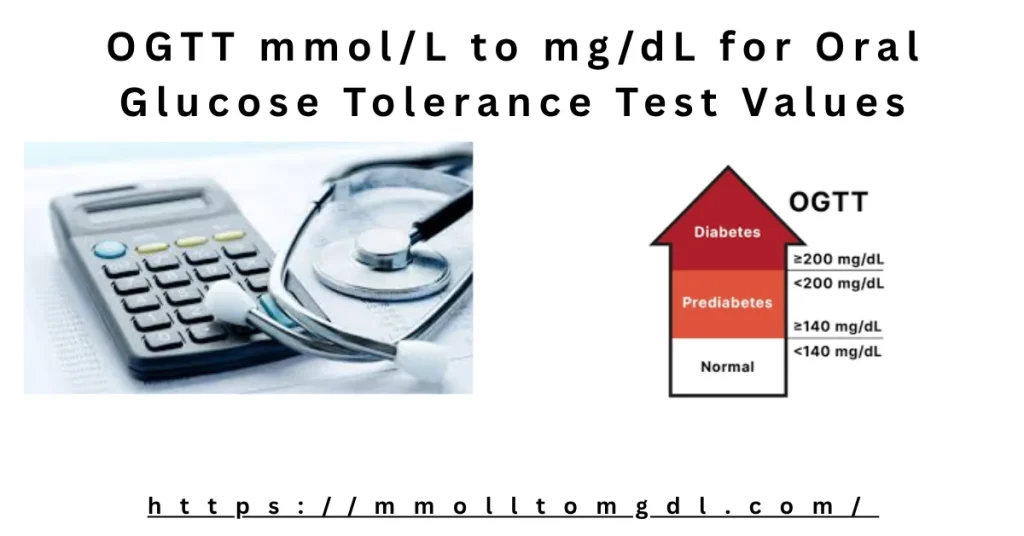
Common OGTT Reference Ranges (2-Hour Test)
Normal: Below 7.8 mmol/L (140 mg/dL)
Prediabetes (Impaired Glucose Tolerance): 7.8 to 11.0 mmol/L (140–199 mg/dL)
Diabetes: 11.1 mmol/L (200 mg/dL) or higher
These ranges apply to non-pregnant adults. Gestational diabetes uses slightly different thresholds.
Gestational Diabetes and OGTT Conversion
During pregnancy, OGTT is often performed between 24 and 28 weeks. The test may include fasting, 1-hour, and 2-hour values.
Many countries report gestational OGTT in mmol/L. If guidelines are referenced in mg/dL, conversion becomes necessary.
For example:
• 5.1 mmol/L fasting equals 91.8 mg/dL
• 10.0 mmol/L equals 180 mg/dL
• 8.5 mmol/L equals 153 mg/dL
These thresholds are commonly used in gestational diabetes diagnosis.
When Should You Convert OGTT Values?
You may need to convert OGTT readings if:
• Your lab report is from another country
• You are comparing medical literature
• You are reviewing international clinical guidelines
• You are tracking results across different laboratories
The safest way is to use a reliable calculator rather than doing mental math, especially with decimal values.
OGTT vs Fasting vs Random Glucose
OGTT measures the body’s glucose response over time.
Fasting Blood Sugar (FBS) measures baseline glucose after fasting.
Random Blood Sugar (RBS) measures glucose at any time of day.
Although the conversion factor (×18) remains the same for all glucose tests, interpretation differs based on test type and timing.
Clinical Importance of Accurate Unit Conversion
Glucose thresholds are precise. Even small differences matter. A value of 10.9 mmol/L is not the same as 11.1 mmol/L in diagnostic context.
If converted incorrectly, it could shift a result from prediabetes to diabetes or vice versa. That is why calculators like the one above are useful for both patients and healthcare professionals.
Frequently Asked Questions
How do I convert OGTT from mmol/L to mg/dL?
Multiply the mmol/L value by 18 to get mg/dL.
What is 7.8 mmol/L in mg/dL?
7.8 × 18 = 140.4 mg/dL (approximately 140 mg/dL).
What is 11.1 mmol/L in mg/dL?
11.1 × 18 = 199.8 mg/dL (approximately 200 mg/dL).
Is the conversion factor the same for all glucose tests?
Yes. For glucose (including OGTT, fasting, and random), the factor is always 18.
Is 200 mg/dL after OGTT high?
Yes. A 2-hour value of 200 mg/dL (11.1 mmol/L) or higher is consistent with diabetes.