
To convert total cholesterol from mmol/L to mg/dL, multiply the value by 38.67. This gives you the equivalent result used in US laboratory reports.
Total Cholesterol Calculator
Conversion settings
Cholesterol results are often reported in different units depending on the country. Many European and Asian laboratories use mmol/L, while the United States commonly reports cholesterol in mg/dL.
If you are comparing lab reports, reviewing medical guidelines, or tracking your lipid profile over time, understanding how to convert these values correctly is essential.
What Is Total Cholesterol?
Total cholesterol represents the overall amount of cholesterol circulating in your blood. It includes:
• Low-Density Lipoprotein (LDL) cholesterol
• High-Density Lipoprotein (HDL) cholesterol
• A portion of triglyceride-related lipoproteins (such as VLDL)
It is one of the primary markers used in lipid panels to assess cardiovascular risk. While total cholesterol alone does not tell the full story, it provides an important starting point.
Understanding mmol/L and mg/dL
mmol/L (millimoles per liter) measures the number of cholesterol molecules in a liter of blood.
mg/dL (milligrams per deciliter) measures the mass or weight of cholesterol in a given blood volume.
Both units are scientifically correct. They simply represent concentration differently. The difference comes from cholesterol’s molecular weight, which determines the conversion factor.
Total Cholesterol Conversion Formula
To convert total cholesterol from mmol/L to mg/dL:
mg/dL = mmol/L × 38.67
To convert from mg/dL back to mmol/L:
mmol/L = mg/dL ÷ 38.67
Examples:
• 5.0 mmol/L × 38.67 = 193.35 mg/dL
• 6.2 mmol/L × 38.67 = 239.75 mg/dL
• 4.5 mmol/L × 38.67 = 174 mg/dL (approx.)
These values are commonly seen in routine lipid panels.
Why the Conversion Factor Is 38.67
Each substance has a specific molecular weight. For cholesterol, this molecular weight determines that 1 mmol/L equals approximately 38.67 mg/dL. This factor is different from glucose, which uses 18, or triglycerides, which use 88.57. Using the correct factor ensures accuracy.
Total Cholesterol Reference Ranges
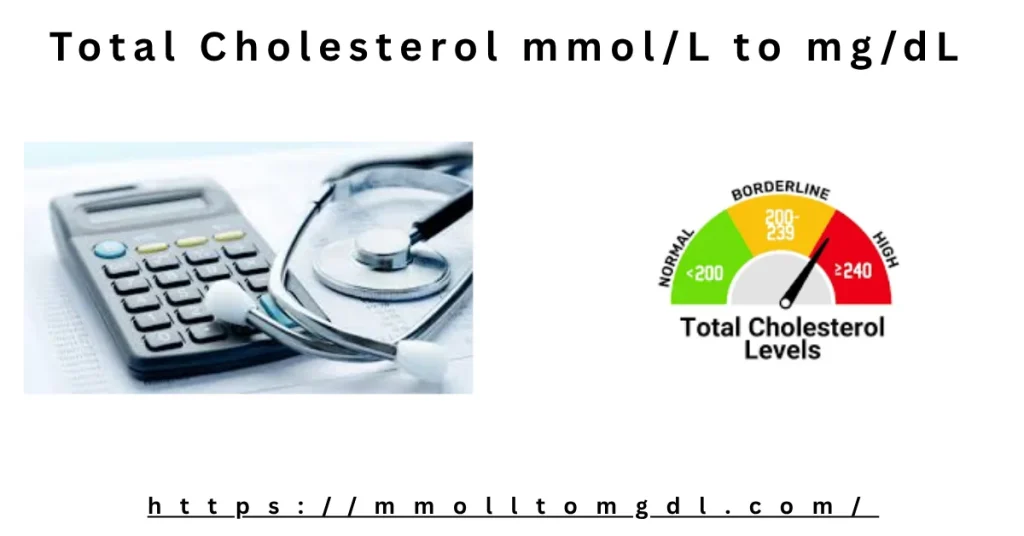
For adults, commonly used reference ranges in mg/dL are:
Desirable:
Below 200 mg/dL
Borderline High:
200–239 mg/dL
High:
240 mg/dL and above
In mmol/L, these roughly correspond to:
Desirable:
Below 5.2 mmol/L
Borderline High:
5.2–6.2 mmol/L
High:
6.2 mmol/L and above
These thresholds are widely used in cardiovascular risk assessment.
Why Accurate Unit Conversion Matters
Cholesterol levels are used to guide lifestyle changes and medication decisions. A misunderstanding of units can lead to confusion.
For example, 5.5 mmol/L may sound small, but it equals about 213 mg/dL, which falls into the borderline-high range.
If someone mistakes mmol/L for mg/dL, they may incorrectly assume their cholesterol is extremely low rather than elevated.
Total Cholesterol in Context
Total cholesterol should not be interpreted alone. Doctors also evaluate:
• LDL cholesterol (“bad” cholesterol)
• HDL cholesterol (“good” cholesterol)
• Triglycerides
• Cholesterol ratios (such as total/HDL ratio)
However, total cholesterol remains a key marker for initial screening and long-term monitoring.
When You May Need to Convert Cholesterol Units
You may need conversion if:
• Your laboratory report is from a different country
• You are reviewing international research
• You moved and your new doctor uses different units
• You are comparing older and newer test results
Using a calculator prevents rounding errors, especially when values include decimals.
Lifestyle and Total Cholesterol
Cholesterol levels are influenced by several factors:
• Diet (especially saturated and trans fats)
• Physical activity
• Body weight
• Genetics
• Smoking status
• Age and gender
Conversion itself does not change the value. It simply ensures correct interpretation.
Total Cholesterol and Cardiovascular Risk
High total cholesterol increases the risk of:
• Coronary artery disease
• Stroke
• Peripheral arterial disease
Risk assessment usually combines cholesterol levels with other factors such as blood pressure, diabetes status, and family history.
Frequently Asked Questions
How do I convert total cholesterol from mmol/L to mg/dL?
Multiply the mmol/L value by 38.67.
What is 5 mmol/L in mg/dL?
5 × 38.67 = 193.35 mg/dL.
Is 6 mmol/L high cholesterol?
6 mmol/L equals about 232 mg/dL, which falls in the borderline-high range.
Why is cholesterol conversion different from glucose conversion?
Each substance has a different molecular weight. Cholesterol uses 38.67, while glucose uses 18.
Is 200 mg/dL high cholesterol?
200 mg/dL is at the upper limit of the desirable range. Values above this may require monitoring.