
To convert urea from mmol/L to mg/dL, multiply the value by 6.006. This gives the equivalent urea concentration commonly reported in US laboratory results.
Urea (BUN-based) Calculator
Conversion settings
Urea is a waste product formed in the liver after protein metabolism. It is transported in the blood to the kidneys, where it is filtered and excreted in urine.
Because urea levels reflect kidney function and hydration status, it is routinely measured in metabolic panels.
Some laboratories report urea directly, while others report Blood Urea Nitrogen (BUN). Although closely related, urea and BUN are not identical. Proper unit conversion is important when interpreting results.
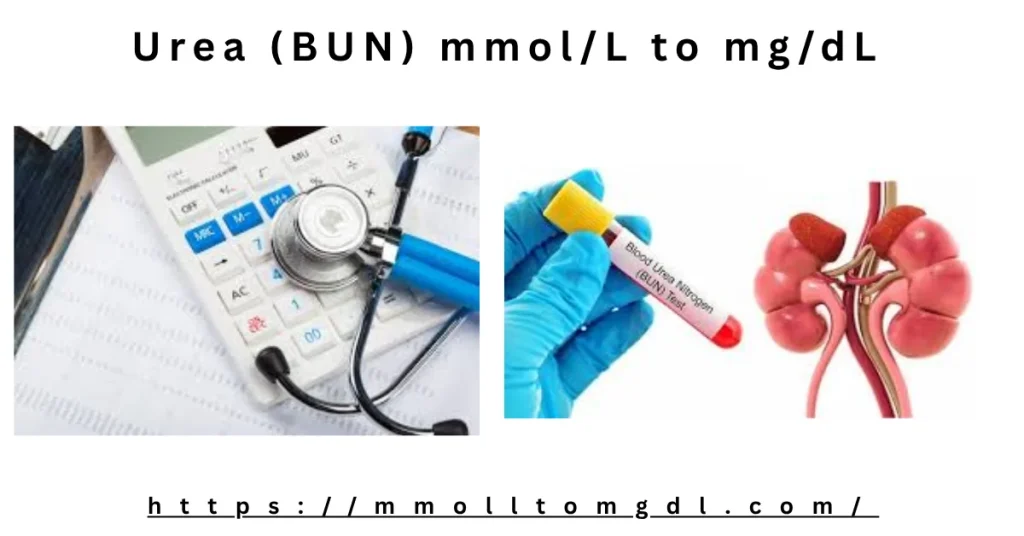
What Is Urea and What Is BUN?
Urea is the full compound produced during protein breakdown.
BUN represents only the nitrogen portion of urea.
In many countries, laboratories report urea in mmol/L. In the United States, BUN is often reported in mg/dL. This difference can cause confusion if the units are not clearly understood.
Urea Conversion Formula
To convert urea from mmol/L to mg/dL (urea value):
mg/dL = mmol/L × 6.006
To convert mg/dL to mmol/L:
mmol/L = mg/dL ÷ 6.006
Examples:
• 5 mmol/L × 6.006 = 30.03 mg/dL
• 7 mmol/L × 6.006 = 42.04 mg/dL
• 10 mmol/L × 6.006 = 60.06 mg/dL
These values fall within commonly observed laboratory ranges.
Important Note About BUN Conversion
If your lab reports BUN instead of total urea, the conversion factor is different. For BUN specifically:
mg/dL (BUN) = mmol/L × 2.8
Always confirm whether your report lists urea or BUN before converting.
Why the Factor Is 6.006
The conversion factor is based on the molecular weight of urea (approximately 60.06 g/mol). This determines how mmol/L translates into mg/dL.
Using the wrong factor could significantly misrepresent kidney function status.
Urea Reference Ranges (mg/dL as Urea)
Typical adult range:
Approximately 15–45 mg/dL (urea value)
In mmol/L, this corresponds roughly to:
2.5–7.5 mmol/L
Ranges may vary slightly between laboratories.
Urea and Kidney Function
Elevated urea levels may indicate:
• Reduced kidney filtration
• Dehydration
• High protein intake
• Gastrointestinal bleeding
• Certain medications
Low urea levels may be seen in:
• Severe liver disease
• Malnutrition
• Overhydration
Urea is often interpreted together with serum creatinine to assess kidney health more accurately.
Urea vs Creatinine
Both urea and creatinine are markers of kidney function, but they behave differently.
Creatinine is more stable and less affected by diet. Urea is more sensitive to hydration and protein intake.
Doctors often evaluate the BUN-to-creatinine ratio when assessing kidney problems.
When You May Need Unit Conversion
You may need to convert urea values if:
• Your lab report uses mmol/L
• Your physician discusses mg/dL
• You are comparing international guidelines
• You are reviewing older test results
Using a calculator prevents rounding errors and ensures accurate interpretation.
Clinical Importance of Accurate Conversion
Urea levels are used to:
• Monitor chronic kidney disease
• Evaluate acute kidney injury
• Assess dehydration
• Guide treatment decisions
Small numerical differences can change interpretation, especially in borderline cases.
Frequently Asked Questions
How do I convert urea from mmol/L to mg/dL?
Multiply the mmol/L value by 6.006.
What is 6 mmol/L urea in mg/dL?
6 × 6.006 = 36.04 mg/dL.
Is high urea dangerous?
Elevated levels may indicate kidney dysfunction or dehydration and require medical evaluation.
What is the difference between urea and BUN?
Urea measures the entire molecule. BUN measures only the nitrogen component of urea.
Is the conversion factor the same as creatinine?
No. Creatinine uses a different factor because it has a different molecular weight.